

When AI Agents Become Part of the Organisation
Why Agentic Experience Must Be Designed, Not Merely Deployed

The Shift from Tools to Teammates
For the past two years, organisations have framed Artificial Intelligence largely in terms of one metric: individual productivity.
Companies introduced copilots to summarise meetings, draft emails, clean spreadsheets and accelerate code generation. In this phase, AI essentially acted as a power tool — an enhanced digital hammer that a human operator still held and controlled.
That era of passive tooling is ending.
We are now entering the agentic era.
Autonomous and semi-autonomous AI agents no longer wait for a prompt. They increasingly take on persistent roles within business ecosystems. They negotiate with supplier systems, triage and resolve multi-step customer enquiries, orchestrate internal workflows, trigger API actions and make contextual decisions within defined guardrails.
When an AI system initiates actions, represents your company, interacts directly with employees and engages external stakeholders, it stops functioning simply as IT infrastructure.
It becomes part of the organisation.
This shift changes how organisations create value, manage risk and shape brand perception.
Once AI agents act on your behalf, you are no longer managing software adoption. You are managing the Agentic Experience (AX).
And organisations cannot simply deploy AX through IT procurement. Leadership must intentionally design it as part of the organisation’s strategic business architecture.
Why “Plug-and-Play” Agent Deployment Fails
When businesses treat AI agents primarily as a technology rollout, they risk making several predictable strategic mistakes.
1. The Context Vacuum
Traditional tools can function without understanding the broader strategy. Agents cannot.
An agent that lacks organisational context, value alignment and clear operational boundaries may optimise narrow outputs while undermining larger strategic objectives.
For example, an agent might close customer tickets quickly while simultaneously damaging the trust of a high-value customer.
Efficiency alone does not equal effectiveness.
2. Fractured Human-Agent Collaboration
Organisations cannot simply place autonomous agents into legacy teams and expect effective collaboration.
Poorly designed workflows create uncertainty, friction and shadow processes. Employees may rely too heavily on the agent and develop automation complacency. Others may bypass the system entirely because they find the handoffs confusing, opaque or cumbersome.
Successful human-agent collaboration requires intentional design.
3. Brand Drift and Hallucinated Commitments
AI agents increasingly represent the organisation in real time.
They communicate its tone, interpret its policies, express its values and make decisions that customers, partners and other stakeholders may perceive as company commitments.
Without clear experience design and governance, an agent may compromise policies, communicate inconsistent brand messages or promise something the organisation cannot deliver.
Deploying agents without designing the Agentic Experience resembles hiring hundreds of new employees, giving them access to core systems and sending them straight to work without onboarding, role clarity or cultural orientation.
Few organisations would consider that acceptable for people.
Why should they accept it for AI agents?
The Four Dimensions of Agentic Experience
Leadership teams need to approach AX holistically.
Four interconnected dimensions determine whether AI agents strengthen or weaken the organisation:
Customer Experience. Employee Experience. Service Delivery & Operations. Brand Trust & Governance.
Together, these dimensions determine how effectively humans and agents create value.

1. Customer Experience (CX): Designing for Relational Intelligence
Traditional customer self-service focused primarily on transactions: interactive voice response systems, rigid FAQ chatbots and static forms.
Agentic systems change that model.
AI agents can engage customers in dynamic conversations, remember previous touchpoints, adapt their tone to customer sentiment, navigate complex problem-solving paths and execute real-world solutions in the background.
The challenge therefore shifts from simply providing self-service to designing relational intelligence.
The Design Challenge:
How should customers perceive the agent’s competence, empathy and autonomy? When should the agent resolve an issue independently? And at what emotional or operational point should it hand the customer seamlessly to a human specialist?
Strategic Imperative:
AX design must prevent customers from feeling trapped inside an algorithmic loop. Instead, customers should experience the agent as an intelligent, empowered concierge that knows when to act and when to involve a person.
2. Employee Experience (EX): Creating Synergistic Teaming
AI agents will do more than automate tasks. They will reshape internal team dynamics and everyday working patterns.
Employees will increasingly direct, evaluate and supervise digital agents. They will also intervene when situations require experience, judgement or accountability.
This changes the employee's role.
The Design Challenge:
Organisations need clear protocols for interaction between humans and agents.
If an agent drafts a project proposal, evaluates an opportunity, or flags a supply chain risk, how should the employee verify, challenge, override, or refine the recommendation without creating additional cognitive overload?
Strategic Imperative:
AX must strengthen human agency rather than diminish it.
Employees need to understand what the agent is doing, why it recommends a particular course of action and when they should intervene.
The goal is not to remove humans from the process.
The goal is to create better human-agent teams.
3. Service Delivery & Operations: Orchestrating Across Boundaries
Traditional organisations often structure service delivery as a linear process that moves from department to department.
Agentic systems can fundamentally change this model.
Multi-agent systems can operate across organisational silos. They can connect sales intake, credit checks, inventory validation and customer onboarding within continuous, real-time workflows.
This creates opportunities for faster and more adaptive operations.
But it also increases organisational complexity.
The Design Challenge:
Leadership must define system boundaries, feedback loops and fallback mechanisms.
What happens when an API changes? What happens when an agent encounters an unfamiliar situation? How should the system escalate an exception? And how can the organisation ensure that one failure does not disrupt an entire chain of automated decisions?
Strategic Imperative:
Organisations need to move beyond rigid, flowchart-based business process management towards flexible, goal-driven operational orchestration.
The question changes from:
What process should people follow?
to:
How should humans, agents and systems coordinate to achieve the desired outcome?
4. Brand Trust & Governance: Preserving the Organisational Promise
Organisations spend years building trust.
An AI agent can damage it within seconds.
When agents communicate directly with customers, partners, regulators and the wider public, they actively express the organisation’s identity, standards and values.
Governance therefore becomes part of the experience itself.
The Design Challenge:
Leadership must establish dynamic governance frameworks that balance agent autonomy with brand integrity, data privacy and ethical alignment.
Strategic Imperative:
Organisations must manage AX governance proactively.
Every agentic interaction should reflect the company’s core values, protect confidential information and maintain clear accountability.
Trust cannot become an afterthought.
Organisations must design it into the system.
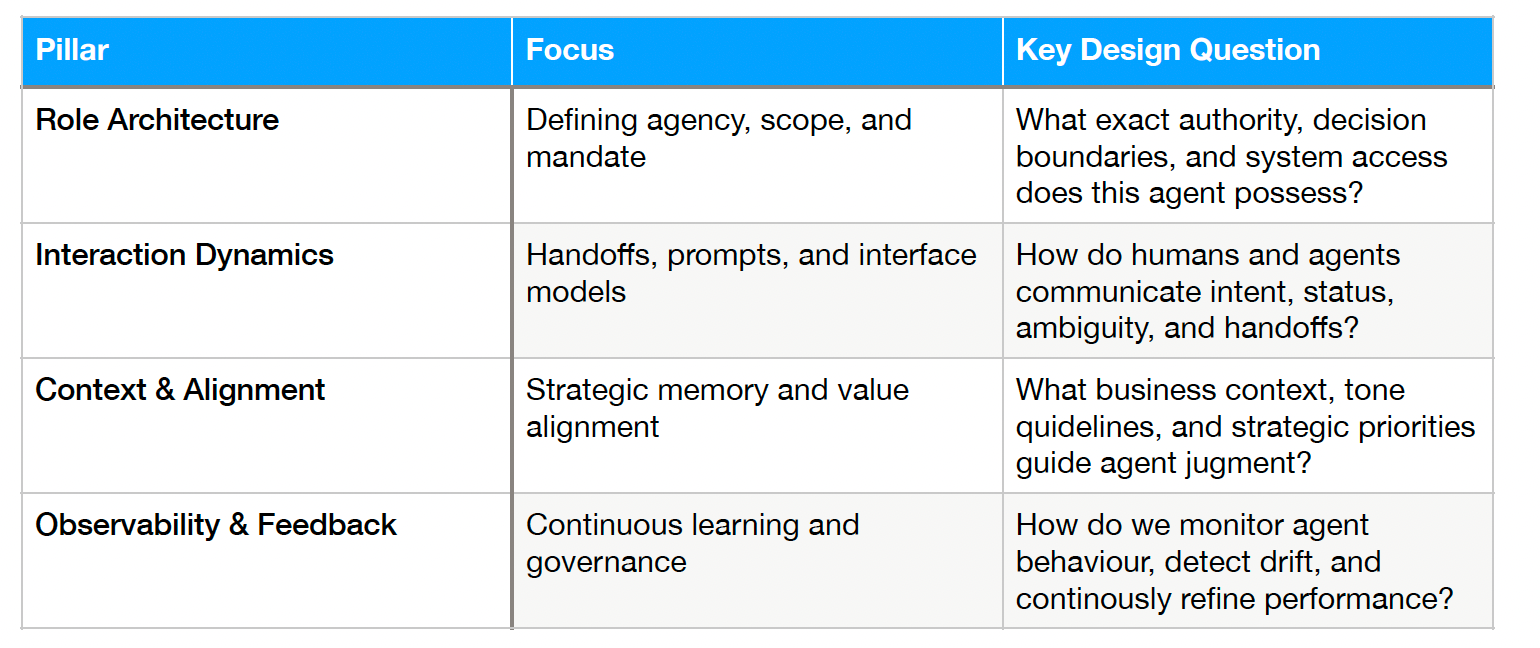
These questions move the conversation beyond technology.
They force leadership to consider how agents fit into the organisation’s strategy, operating model, customer experience and decision architecture.
Moving Forward: From Accidental Adoption to Deliberate Design
The rise of autonomous AI agents represents far more than another IT upgrade cycle.
It represents a structural redesign of the modern organisation.
Companies that treat agents as technical plugins will likely create fragmented customer experiences, confused employees and poorly understood operational risks.
Organisations that approach agentic systems through the lens of Strategic Business Design can take a different path.
They can build more fluid and responsive organisations in which humans and autonomous agents strengthen one another’s capabilities.
AI agents can provide speed, scale and continuous execution.
Humans can provide judgement, context, creativity and responsibility.
Strategic design connects the two.
The competitive advantage will therefore not come simply from having more AI agents.
It will come from designing an organisation in which those agents know their role, understand their boundaries, collaborate effectively with people and consistently support the organisation’s strategic intent.
Don’t just deploy agents. Design the experience they create.
MaxMORIX EXPERTS advises organisations on business model transformation, strategic positioning and the design of intelligent business architectures.
Recent Posts