

Strategy Is Too Slow for Continuous Change
Why organisations need to connect strategic intelligence, decision-making and adaptation throughout the year.

A customer changes how they buy. A competitor introduces a different business model. A new technology challenges the economics of an established service.
None of these developments waits for the next strategy meeting.
Yet many organisations still organise strategy around an annual cycle: analyse the market, agree priorities, approve budgets and communicate the plan. Progress is then measured against decisions made months earlier.
This creates a growing tension. The organisation follows its planning calendar while the conditions behind the plan keep changing.
Long-term direction remains essential. But when strategy takes too long to absorb new evidence and turn it into action, even a carefully developed plan can pull an organisation out of relevance.
The challenge is to make strategy an ongoing organisational practice: one that connects what the business learns with what it decides and how it operates.
When the planning cycle becomes a constraint
Annual planning provides structure. It helps leaders coordinate investment, clarify responsibilities and establish a shared direction.
The problem begins when that structure makes it difficult to respond to changing conditions.
Information may pass through several layers before reaching someone who can act. A frontline observation becomes a report, the report becomes a presentation, and the presentation waits for a scheduled review. By then, an opportunity may have narrowed or a manageable problem may have become expensive.
Approved plans can also become difficult to challenge. Budgets, performance targets and personal commitments are built around them. Questioning an assumption may be interpreted as questioning the competence of those who approved it.
Often, different departments notice different parts of the same problem. Customers may be asking for more flexibility, while sales staff find existing contract terms harder to defend and operations struggles to accommodate exceptions. Unless these teams compare what they are seeing, management may treat each issue separately and miss the need to rethink the offer.
A strategy can remain internally consistent while becoming increasingly disconnected from the market.
Organisations therefore need a way to revisit the assumptions behind their plans throughout the year.
Strategic intelligence needs a route into action.
Strategic intelligence helps an organisation understand what is changing and why it matters. Decision architecture determines how that understanding influences action.
Decision architecture is the arrangement of authority, evidence, responsibilities and incentives through which decisions are made.
The connection between the two is critical. An organisation can identify important signals and still fail to respond because nobody owns the decision, the evidence is disputed, or resources remain locked into existing commitments.
Consider a service business receiving more requests for flexible subscription options. Sales records the demand. Customer support hears similar concerns. Finance continues to measure success through annual contracts, while management postpones discussion until the next budget cycle.
The organisation has information. What it lacks is a clear process for assessing that information, deciding whether to test a different offer and assigning responsibility.
Continuous strategy requires that process.
Put decisions at the right level.
Some decisions deserve extensive scrutiny. Major acquisitions, substantial investments and commitments that are difficult to reverse require careful deliberation.
Others can be tested within defined limits. Adjusting a customer journey, piloting a service or exploring a different pricing structure should not automatically require the same approval process.
Leaders need to distinguish between these decisions and make the boundaries explicit.
Who can authorise an experiment? What budget is available? Which risks require escalation? When must a decision return to the executive team?
Giving teams authority works best when they understand the strategic purpose, the limits of their mandate and the results they must report.
This allows people close to an emerging issue to respond while leadership retains oversight of consequential commitments.
The aim is to match scrutiny to the decision’s consequences.
Make strategic assumptions visible.
Every strategy rests on assumptions: what customers value, how demand will develop, which capabilities will matter and where the business can create value profitably.
Too often, these assumptions disappear behind targets and project plans. Organisations track delivery without checking whether the original reasoning still holds.
A more adaptive approach makes the critical assumptions explicit and assigns responsibility for reviewing them.
For example, if a growth strategy depends on customers paying a premium for personal advice, leaders should examine whether customers still value that advice, which groups value it most and what alternatives they are adopting.
Evidence should then lead to a defined response. Some findings warrant further investigation. Others justify a limited experiment or a wider strategic review.
A single observation rarely settles the question. The purpose is to establish a disciplined way to recognise when an assumption needs attention.
Reward learning and responsible adaptation
An organisation cannot expect people to challenge a strategy if their rewards depend entirely on delivering the original plan.
When annual targets dominate performance discussions, managers may delay reporting weak demand, defend struggling initiatives or continue spending on projects whose rationale has weakened.
Accountability should include both delivery and the quality of the judgement behind it.
Did the team recognise a changing condition early? Did it test its interpretation? Did it stop an unsuccessful experiment before costs escalated? Did it use the findings to improve the next decision?
These questions make adaptation part of responsible management.
Changing course should require an evidence-based explanation. Equally, continuing on the same course should remain a decision that leaders can justify.
Use AI to support strategic review.
AI can support this process by helping teams organise observations, summarise information, compare interpretations and develop alternative scenarios.
For example, an organisation could use AI to bring together customer feedback, sales notes and operational reports, then examine recurring themes that deserve human attention.
It can also help leaders explore how a proposed decision might perform under different assumptions.
These uses require care. An AI-generated scenario is a possibility to examine, not a forecast to trust. A persuasive summary may omit context or reflect weaknesses in its source material.
The quality of the information, the questions asked and the review process all matter.
AI can help prepare a decision. Leaders remain responsible for its reasoning, consequences and oversight.
Give strategy a working rhythm.
Continuous strategy does not mean constant strategic upheaval. An organisation that changes priorities with every new signal will struggle to build anything lasting.
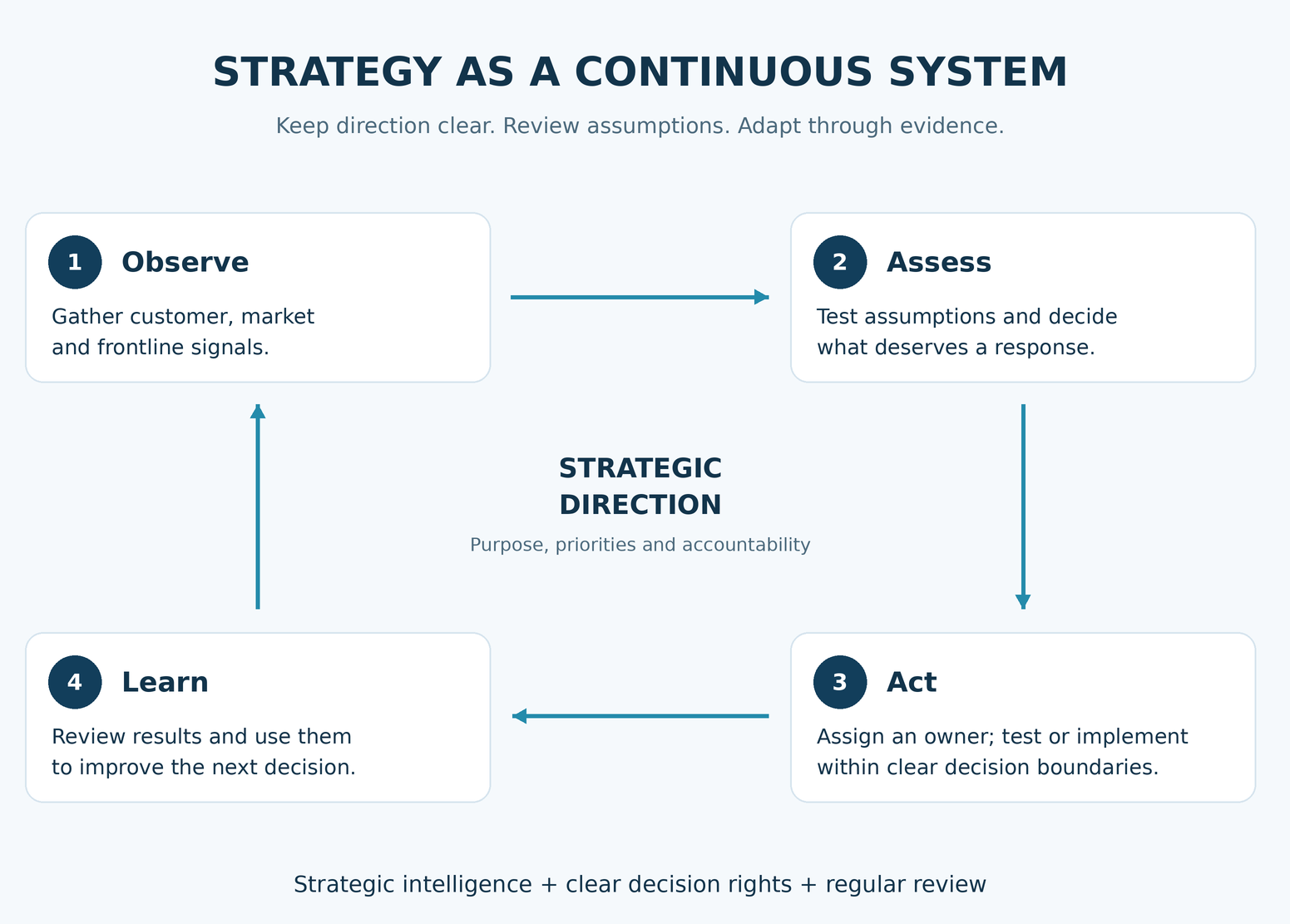
A useful working rhythm combines long-term direction with regular opportunities to review evidence and adjust action.
Teams can share observations as they arise. Managers can review experiments and emerging patterns at suitable intervals. Executive teams can examine whether the organisation’s most important assumptions still hold. More substantial decisions can receive deeper scrutiny when the evidence warrants it.
The frequency should reflect the business and the consequences of delay.
What matters is that the connection works: observations reach the right people, decisions have owners, and the results feed back into the organisation’s understanding.
Keep direction clear and assumptions open.
A strategy should give people enough clarity to act and enough flexibility to respond when circumstances change.
That requires leaders to distinguish between enduring purpose, strategic commitments and assumptions that remain open to revision.
The central question is simple:
When something important changes, how quickly can your organisation understand it, decide what it means and respond?
The answer reveals whether strategy is functioning as a practical guide to the business—or waiting for its next scheduled update.
Where does your strategy get stuck?
At MaxMORIX EXPERTS, we help leaders examine how strategic intelligence becomes decisions and practical action.
A focused Strategy Diagnostic can identify where signals are lost, responsibilities are unclear, or approval processes delay a response. Together, we define practical changes to decision-making and Business Design that help the organisation adapt.
Recent Posts