The Intelligence Paradox
Modern organisations have access to more intelligence than ever before.
They have dashboards, real-time data, customer analytics, AI systems, market research, trend reports and increasingly sophisticated tools for detecting change. Employees contribute experience and judgement. AI agents can analyse information at unprecedented speed. Future Thinking helps organisations identify emerging signals before they become obvious.
Yet many organisations still struggle to act.
The problem is no longer simply a lack of information. It is the inability to connect information with decisions — and decisions with meaningful organisational change.
Intelligence only matters when it changes how the organisation works.
This is the intelligence paradox. Organisations can become increasingly sophisticated at observing their environment while remaining remarkably slow at adapting to it.
The solution isn't another dashboard or technology platform. It is an operating model that connects Business Intelligence, human insight, AI agents, Future Thinking and Business Design into one organisational capability.
The Strategic Intelligence Series: Bringing the Pieces Together
Throughout the Strategic Intelligence Series, we have explored a recurring question:
How can organisations turn data, signals, people and AI into better decisions?
Business Intelligence can tell leaders what has happened and what is happening now. Employees often detect changes in customer behaviour and operational friction before these developments appear in formal reporting. AI can identify patterns, analyse alternatives and increasingly perform tasks autonomously. Future Thinking helps organisations look beyond current assumptions and explore what may be emerging.
But none of these capabilities is sufficient on its own.
Strategic Intelligence becomes valuable only when the organisation can translate what it learns into action.
That requires a bridge between insight and execution.
That bridge is Business Design.
Five Elements of the Intelligent Organisation
An intelligent organisation does not treat data, human judgement, AI, foresight and organisational design as separate disciplines. It connects them.
1. Business Intelligence: Understand what is happening
Business Intelligence provides the evidence base.
It helps organisations understand performance, customer behaviour, operational developments and changes in key metrics. It reveals where performance is improving, where friction is emerging and where assumptions may no longer reflect reality.
But BI predominantly tells us what has happened or what is happening.
It does not automatically tell us what will matter next.
2. Human Insight: Understand what the numbers cannot see
Employees, customers and partners provide something quantitative systems cannot fully capture: context.
People recognise subtle changes in behaviour, frustration, expectations and culture. They notice when customers begin asking different questions, when processes no longer make sense or when established ways of working begin to create resistance.
This tacit knowledge is often messy and difficult to measure. It is also strategically valuable.
An intelligent organisation creates mechanisms for these observations to reach decision-makers, rather than letting them remain trapped at the organisation's edges.
3. AI Agents: Increase speed, scale and responsiveness
AI is moving beyond analysing information.
Agents can increasingly monitor systems, identify patterns, synthesise large volumes of information, support decisions and execute defined activities across organisational workflows.
This creates enormous potential.
But more autonomous technology does not automatically make an organisation more intelligent.
AI can accelerate poor processes just as effectively as good ones. It can optimise activities that may no longer exist. It can also produce recommendations without understanding their strategic, cultural, or organisational implications.
The question is therefore not simply:
Where can we use AI?
It is:
How should AI change the way the organisation operates?
4. Future Thinking: Understand what may be changing
Business Intelligence looks primarily at evidence that already exists.
Future Thinking looks for what may be emerging.
It identifies weak signals, structural shifts, changing behaviours, new technologies and alternative scenarios that may challenge current assumptions.
Its purpose is not to predict one future.
It broadens the organisation's field of vision so leadership can recognise possibilities before they become unavoidable realities.
This matters because organisations rarely fail only because they misunderstood the present.
They often fail because they remain committed to assumptions the future has already begun to invalidate.
5. Business Design: Turn intelligence into organisational change
This is where the elements come together.
Business Design translates intelligence into changes in how the organisation creates value and works.
It asks what new insight means for the value proposition, customer experience, services, processes, decision rights, incentives, organisational structures and business model.
If customer behaviour changes, what needs to change in the offering?
If AI agents can perform parts of an existing workflow, should the organisation redesign that workflow rather than merely automate it?
If Future Thinking reveals a significant emerging risk, where must the organisation build resilience?
If employees repeatedly identify the same operational friction, what structures or processes prevent the organisation from responding?
Business Design turns these questions into action.
It is the connective tissue between understanding and execution.
From Insight to Adaptive Capability
The intelligent organisation can be understood as a continuous cycle:
Signal → Interpretation → Decision → Design → Action → Feedback → Learning
A signal may originate in customer behaviour, financial data, an employee observation, an AI system or a development detected through horizon scanning.
But identifying a signal is only the beginning.
The organisation must interpret what it means.
It must decide whether the signal matters.
It must determine what should change.
It must redesign the relevant parts of the business.
And it must observe what happens next.
This final step is frequently underestimated.
An adaptive organisation needs feedback.
Decisions generate outcomes. Outcomes produce new information. That information helps the organisation test assumptions, improve future decisions and adjust its operating model again.
Strategic Intelligence therefore cannot be an occasional management exercise.
It must become a learning system.
And this is where organisational intelligence becomes an adaptive capability.
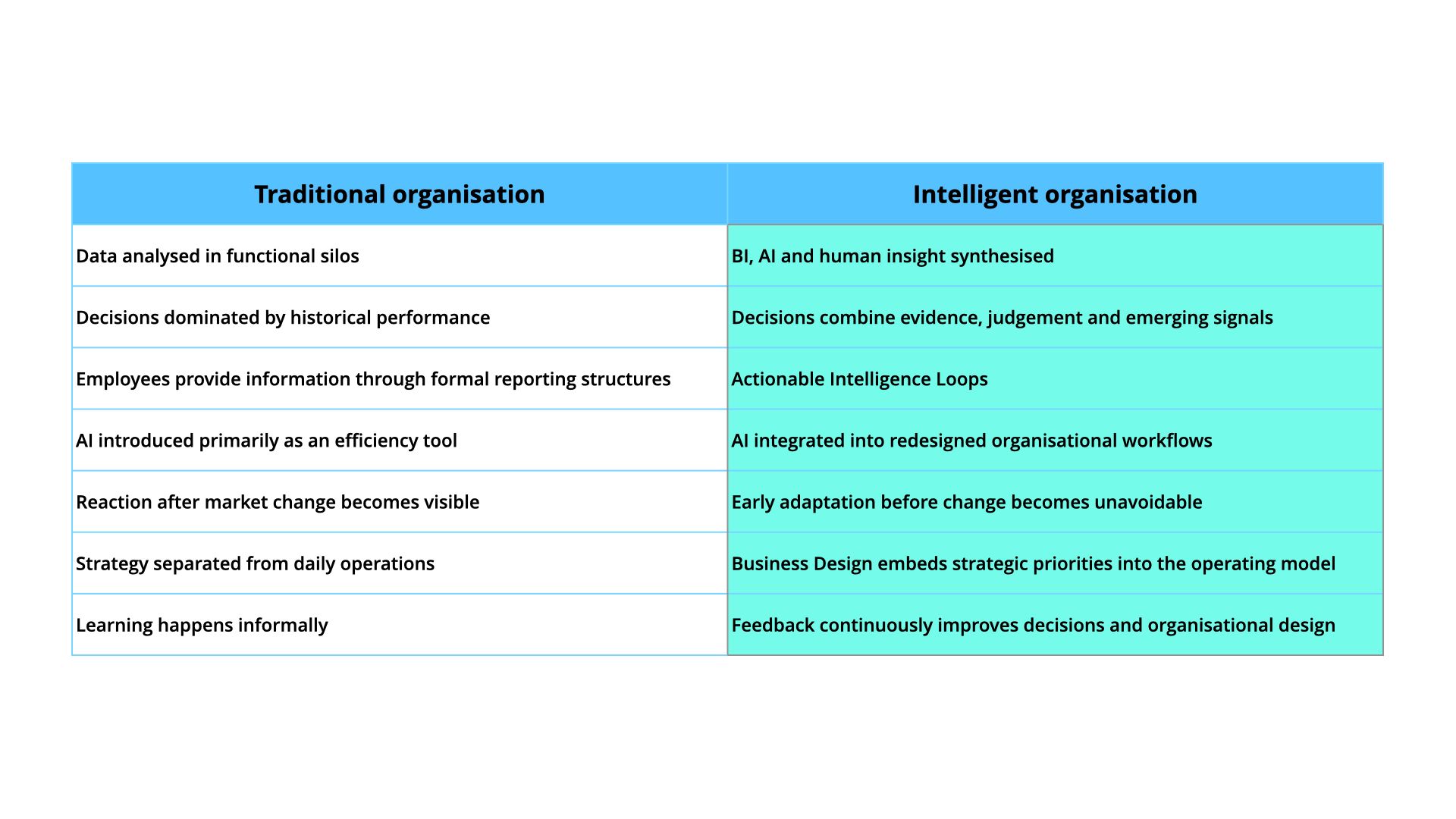
From Traditional Organisation to Intelligent Organisation
The difference is not primarily technological.
It is organisational.