The Decision Architecture Series — Blog #19
Seeing change is no longer enough.
Most organisations today have access to more information, market intelligence and technological capability than ever before. Yet many still struggle to respond quickly when conditions change.
The problem is often not a lack of insight.
It's how the organisation is designed to turn insight into decisions.
Many of the structures we still rely on were built for a more predictable environment. Hierarchies, approval chains and functional boundaries provided control, consistency and risk management when markets moved more slowly.
Those systems were not badly designed.
They were designed for a different world.
When control becomes friction
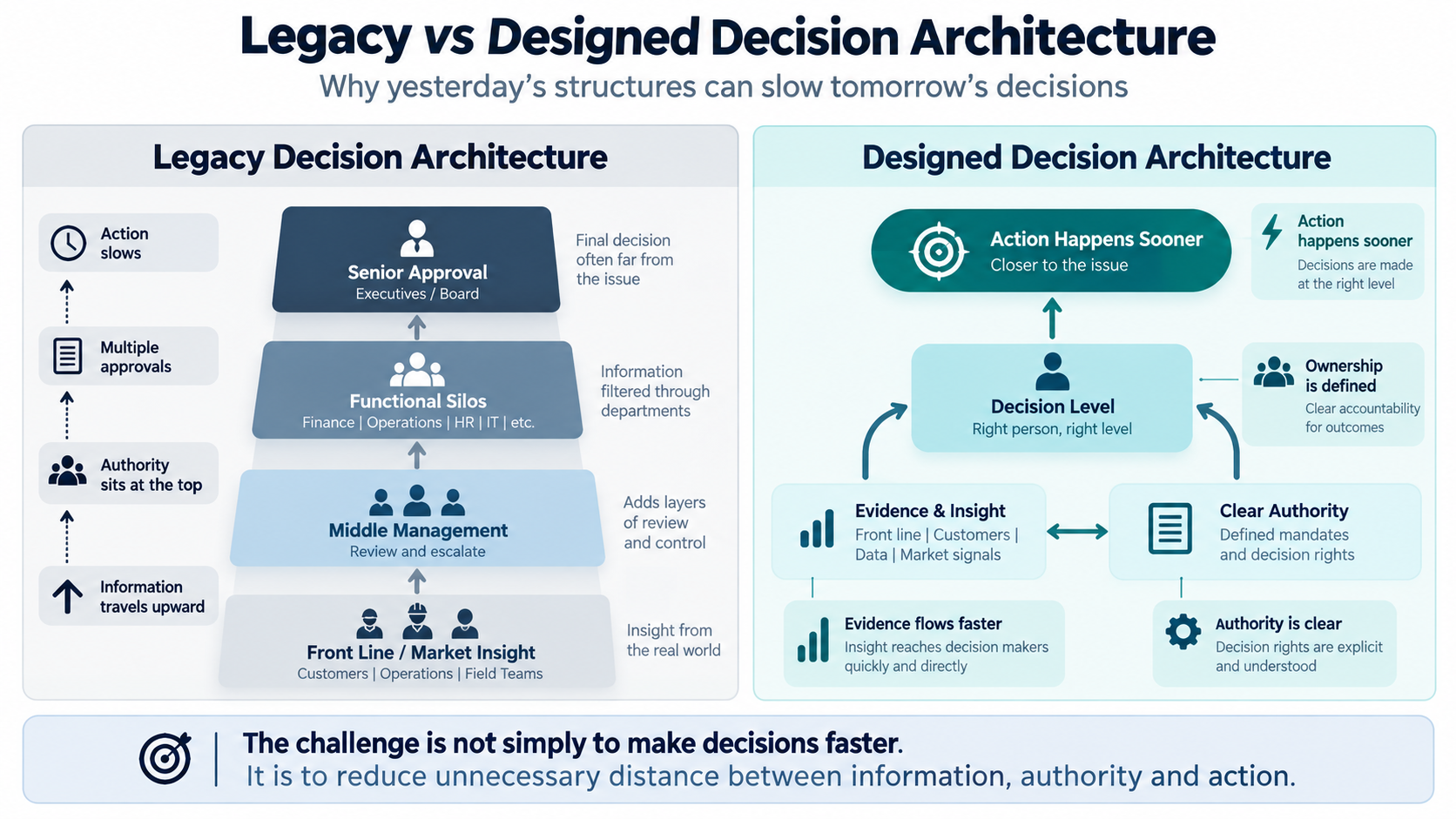
Traditional organisations often separate information from authority.
Employees closest to customers, operations and markets may recognise a change early. But the authority to respond often sits several levels above them.
Information therefore moves upwards while decisions move downwards.
At every stage, context can be lost. Evidence may be summarised, filtered or delayed. More people become involved. Additional approvals are requested. By the time the organisation is ready to act, the original opportunity may have changed — or disappeared.
This does not mean that hierarchy is inherently wrong. Some decisions require senior oversight, specialist expertise or strong governance.
The problem arises when
every important decision follows the same path, regardless of its urgency, risk or proximity to the customer.
That is where Decision Architecture begins to matter.
The distance between insight and authority
Imagine that a company identifies a significant shift in customer behaviour.
The evidence is strong. The market signal is clear. Yet responding requires a revised budget, approval from several functions and a decision from senior management.
The organisation has seen the change.
But it cannot move.
This is the critical gap between
strategic intelligence and organisational action.
Future Thinking helps organisations recognise emerging change. It helps leaders identify signals, explore possible futures, and understand what may come next.
Business Design addresses a different question:
Can the organisation actually respond to what it sees?
Decision Architecture connects the two.
It determines where authority sits, how evidence reaches decision-makers, who owns the outcome and how quickly a decision can move into action.