

Human Inside
Why Frontline Staff Often Detect Change Before Leadership Does.

Strategic intelligence does not begin with a dashboard.
It often begins with somebody noticing that something feels different.
A salesperson hears customers asking questions they did not ask six months ago. A service employee notices that a supposedly simple process requires more explanation. An operations team creates another workaround because the system no longer fits the reality of the work. A customer-facing employee senses hesitation even though sales numbers still look acceptable.
None of these observations may appear significant on their own. But together, they can reveal something leadership has not yet seen.
The people closest to customers, systems, suppliers, workflows, and day-to-day operations frequently encounter change before it becomes measurable. They are not predicting the future. They are experiencing the emerging present before it reaches the boardroom.
That makes them an essential part of an organisation’s strategic intelligence system.
The question is whether anyone is listening.
Leadership Is Often Furthest from the Signal
Senior leaders have access to more information than almost anyone else in the organisation.
But they are not necessarily closest to reality.
As information moves upwards through an organisation, it is filtered, summarised, categorised, and converted into KPIs, reports, presentations, and management updates. This is necessary. Leadership cannot absorb every individual customer conversation or operational issue.
But something important can disappear in the process: context.
A dashboard may show that customer satisfaction remains stable. It cannot easily show that customers are becoming more impatient.
A report may show that service levels remain within target. It may not reveal that employees are performing increasingly complex manual interventions to maintain them.
Sales may remain acceptable while customers take longer to decide, ask different questions, or compare entirely new alternatives.
By the time these behavioural changes become clearly visible in traditional metrics, they may no longer be weak signals.
They may already be established trends.
Practical Tip 1: Ask what people are noticing, not only what they are reporting.
Add one simple question to regular team discussions:
“What are you seeing or hearing that feels different from six months ago?”
The answer may reveal more about emerging change than another performance update.
Friction Is Often Intelligence in Disguise
Organisations naturally try to eliminate friction.
A process fails, so someone fixes it. A customer becomes confused, so an employee explains the problem. A system produces the wrong result, so somebody corrects it manually.
The immediate problem disappears. But the strategic signal can disappear with it.
Repeated friction is rarely just an operational inconvenience. It can reveal that expectations, processes, technologies, customer behaviours, or business assumptions are beginning to move out of alignment.
A single exception is probably noise.
Twenty similar exceptions may be intelligence.
This distinction matters.
If employees are continually correcting the same type of problem, the organisation should not simply ask:
“How do we solve this faster?”
It should also ask:
“Why is this happening more often?”
That second question moves the issue from operational management towards strategic intelligence.
Practical Tip 2: Track recurring friction, not just resolved problems.
Do not measure only how quickly issues are closed. Look for recurring categories of friction, exceptions, manual interventions, customer confusion, and informal workarounds.
Resolution tells you that the organisation reacted.
Recurrence tells you that something may be changing.
Dedicated Staff Can Make Weak Systems Look Strong
One of the paradoxes of organisational performance is that excellent employees can disguise poor systems.
Dedicated staff compensate. They remember exceptions the software does not recognise. They manually connect information between systems. They contact colleagues directly when official processes become too slow. They reassure customers when an experience does not work as intended.
This dedication is enormously valuable.
But leadership can draw the wrong conclusion from it.
If committed employees continually absorb operational weaknesses, the organisation may appear healthier than it really is. Service levels remain acceptable. Customers remain satisfied enough. The dashboard stays green.
Underneath, however, human effort is compensating for structural weakness. The organisation is not performing because its Business Design works particularly well. It is performing because its people refuse to let it fail.
That is not organisational resilience. It is hidden dependency.
Practical Tip 3: Separate system performance from human compensation.
Ask teams:
“Where would this process fail if people stopped making extra effort to keep it working?”
Those areas deserve leadership attention.
Why Frontline Signals Rarely Reach Strategy
Most organisations already collect employee feedback.
That does not mean they have a strategic sensing system.
Suggestion boxes, engagement surveys, team meetings, service tickets, CRM notes, and employee conversations contain enormous amounts of information. But much of it remains fragmented.
There are several reasons:
Employees may assume an observation is too small to matter. Managers may classify it as an operational issue. Teams solve problems locally rather than escalating them. Negative signals may be softened as they travel upwards. And leadership systems are usually designed to review recognised metrics rather than unstructured observations.
The organisation therefore possesses the intelligence but fails to connect it.
This is the difference between having information and having strategic intelligence.
Strategic intelligence requires a pathway through which weak observations can be captured, compared, interpreted, and—when necessary—translated into action.
Without that pathway, signals remain anecdotes.
With it, patterns become visible.
Build a Human Signal Loop
The goal is not to send every frontline observation directly to the executive team.
That would replace data overload with anecdote overload.
The organisation needs a structured signal loop:
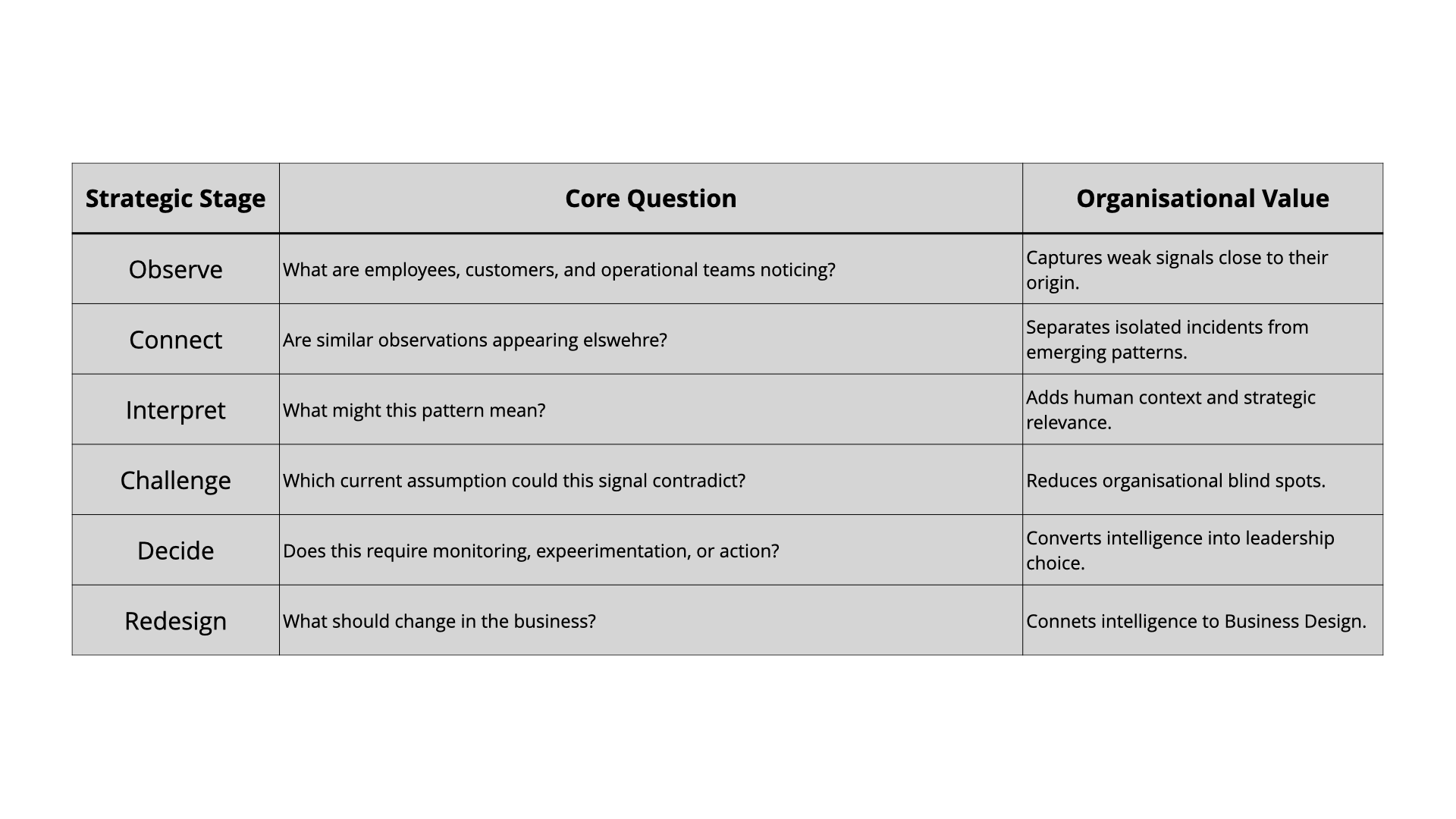
This is where Business Intelligence becomes much more than reporting.
Traditional BI primarily asks what the organisation’s data is saying.
Strategic Intelligence asks a broader question:
What is reality trying to tell us?
The answer may come from data.
But it may equally begin with a customer conversation, a recurring workaround, a supplier concern, a behavioural shift, or an employee saying:
“We keep seeing this lately.”
AI Can Multiply Human Intelligence
This is where AI becomes particularly interesting.
Organisations generate enormous amounts of unstructured operational intelligence every day: customer notes, service conversations, internal comments, complaints, observations, CRM entries, workflow exceptions, and employee feedback.
Humans are excellent at understanding context.
They are much less efficient at continuously analysing thousands of fragmented observations across an organisation.
AI agents can help bridge that gap.
A strategically designed AI agent could collect frontline observations, classify them, identify recurring themes, detect anomalies, compare signals across departments, and highlight patterns that might otherwise remain invisible.
It could notice that sales teams in three regions are independently reporting longer decision cycles.
It could connect growing customer complaints with a rise in internal manual workarounds.
It could identify instances where employees repeatedly use language such as “confusing”, “slow”, “manual”, or “customers keep asking”.
This does not make the AI the strategist.
It makes AI the signal amplifier.
The machine helps detect the pattern.
Humans decide what the pattern means.
Practical Tip 4: Use AI to find patterns, not to make the final judgement.
Ask AI-enabled systems to surface recurring signals, contradictions, anomalies, and emerging themes.
Then bring those findings back to the people who understand the context.
AI can tell you that something is happening.
It cannot automatically tell you why it matters.
The Risk of Automating Away the Signal
There is also a danger.
If AI is introduced primarily to speed up and streamline processes, organisations may unintentionally automate away valuable human intelligence.
Consider a customer-service process.
An employee may notice hesitation, frustration, emotional tone, unusual questions, or a change in expectations. These observations may never appear in the formal case record.
An automated system could resolve the transaction faster while capturing even less of that context.
The process becomes more efficient.
The organisation becomes less perceptive.
This is why Agentic Experience (AX) matters.
AI agents should not simply be designed around task completion. Their role should include helping the organisation understand what is changing around the task.
A good internal agent should not only ask:
“Was the case resolved?”
It should help surface:
“What are we seeing repeatedly that leadership should know?”
“Efficiency without awareness can make an organisation faster while reducing its ability to sense change.”
Human Judgement Becomes More Valuable, Not Less
As AI becomes better at collecting, processing, summarising, and analysing information, something interesting happens.
Human judgement becomes more important.
The scarce capability is no longer access to information.
It is the ability to interpret meaning.
Is a rise in complaints temporary noise or evidence of a changing expectation?
Is a new customer behaviour marginal or the beginning of a structural shift?
Is an employee workaround evidence of poor training, poor technology, or a business process that no longer makes sense?
Should leadership react immediately, watch the signal, run an experiment, or deliberately do nothing?
These are judgement questions.
They require context, experience, empathy, trade-offs, and an understanding of the organisation’s strategic direction.
AI can strengthen this process enormously.
But it cannot remove leadership responsibility for interpretation and choice.
From Listening Organisation to Sensing Organisation
Many companies describe themselves as listening organisations.
A strategically intelligent organisation needs to go further.
It must become a sensing organisation.
Listening is passive.
Sensing is systematic.
A sensing organisation deliberately creates mechanisms for detecting small changes before they become large problems. It combines quantitative data with qualitative observation. It connects frontline reality with leadership attention. It examines anomalies rather than smoothing them away.
“Most importantly, it creates the conditions in which employees can surface inconvenient truths.”
That requires more than technology.
It requires psychological safety.
If employees learn that uncomfortable information is ignored, explained away, or treated as criticism, they will eventually stop providing it.
A strategic intelligence system, therefore, depends on culture as much as on data architecture.
People must believe that noticing something is valuable—even when they cannot yet prove exactly what it means.
Practical Tip 5: Create a recurring “weak signal” conversation.
Once a month, ask customer-facing and operational teams to bring one observation that does not yet appear significant enough for a KPI.
Then ask three questions:
- Are we seeing this elsewhere?
- Which assumption might this challenge?
- What would we want to know if this became a significant trend?
This turns everyday observation into structured Future Thinking.
Leadership Must Design the Connection
The solution is not to give leadership more information.
It is to design a better connection between information, interpretation, and decisions.
Frontline teams provide proximity to reality.
Business Intelligence provides patterns and evidence.
AI agents increase processing capacity and detect connections.
Future Thinking helps leadership explore what emerging signals could mean.
Business Design translates those insights into changes in processes, capabilities, services, customer experiences, and business models.
And human judgement decides which signals deserve attention.
This is Strategic Intelligence as an organisational capability rather than a reporting function.
It connects:
Human Observation → Data → AI Pattern Recognition → Human Interpretation → Strategic Decision → Business Design
Remove the human observation at the beginning, and the system risks analysing only what it already knows how to measure.
Remove human judgement at the end, and the organisation risks confusing automated interpretation with strategic understanding.
Both matter.
The Future May Already Be Inside Your Organisation
Organisations spend considerable resources looking outside for signals of change.
They follow trends. Commission research. Analyse competitors. Purchase market intelligence. Attend conferences. Explore emerging technologies.
All of this has value.
But some of the most important signals may already exist inside the organisation.
They are present in the customer conversation that suddenly feels different.
In the employee who keeps encountering the same exception.
In the process that needs another workaround.
In the question customers have started asking more frequently.
In the small operational irritation that everybody has learned to tolerate.
These observations may look insignificant.
That is precisely what makes them weak signals.
The role of Strategic Intelligence is to notice them before they become obvious.
Human Inside
Every organisation already has a distributed human sensing network.
Its employees.
The strategic advantage does not come simply from having dedicated people. It comes from creating the structures that allow what those people see, hear, experience, and question to influence decisions.
AI can strengthen that network.
Business Intelligence can structure it.
Future Thinking can interpret its implications.
Business Design can turn insight into change.
But the first signal may still come from a human being saying:
“Something is changing here.”
Leadership should make sure someone is listening.
How effectively does your organisation connect what frontline employees notice with the strategic decisions made at the top?
MaxMORIX EXPERTS helps organisations connect Business Intelligence, human insight, AI-enabled decision support, Business Design, and Future Thinking to identify weak signals earlier and turn them into better strategic decisions.
Book a Strategy Diagnostic to explore whether important signals are already present inside your organisation—but not yet reaching leadership.
Recent Posts