Throughout this series, I have argued from a position of confident optimism. Artificial intelligence is one of humanity’s most consequential achievements. It accelerates discovery, expands access to expertise and creates opportunities that would have been unimaginable only a few years ago.
But optimism must survive difficult questions. Few are more challenging than the use of AI in warfare.
The debate often presents two extremes: AI as an unacceptable military threat or AI as an inevitable development that cannot be restrained. Neither position is particularly helpful.
We can support technological progress while drawing clear boundaries around its application. The central question is not whether AI should play a role in military operations, but where human judgement must remain decisive.
Not All Military AI Is the Same
Modern armed forces depend on complex logistics, maintenance, intelligence analysis and medical coordination. AI can improve these activities substantially.
Predictive maintenance can identify technical problems before equipment fails. Intelligent logistics can accelerate the delivery of essential supplies. AI-assisted analysis can support the identification of unexploded ordnance, improve situational awareness and potentially help protect civilian populations.
These applications show that military AI can improve efficiency and safety.
However, the risks change fundamentally when AI influences decisions involving lethal force.
Systems that identify potential targets, recommend attacks or independently select and engage targets raise questions that cannot be answered through conventional measures of operational efficiency.
At stake are human lives, the protection of civilians and compliance with international humanitarian law.
When Speed Outruns Judgement
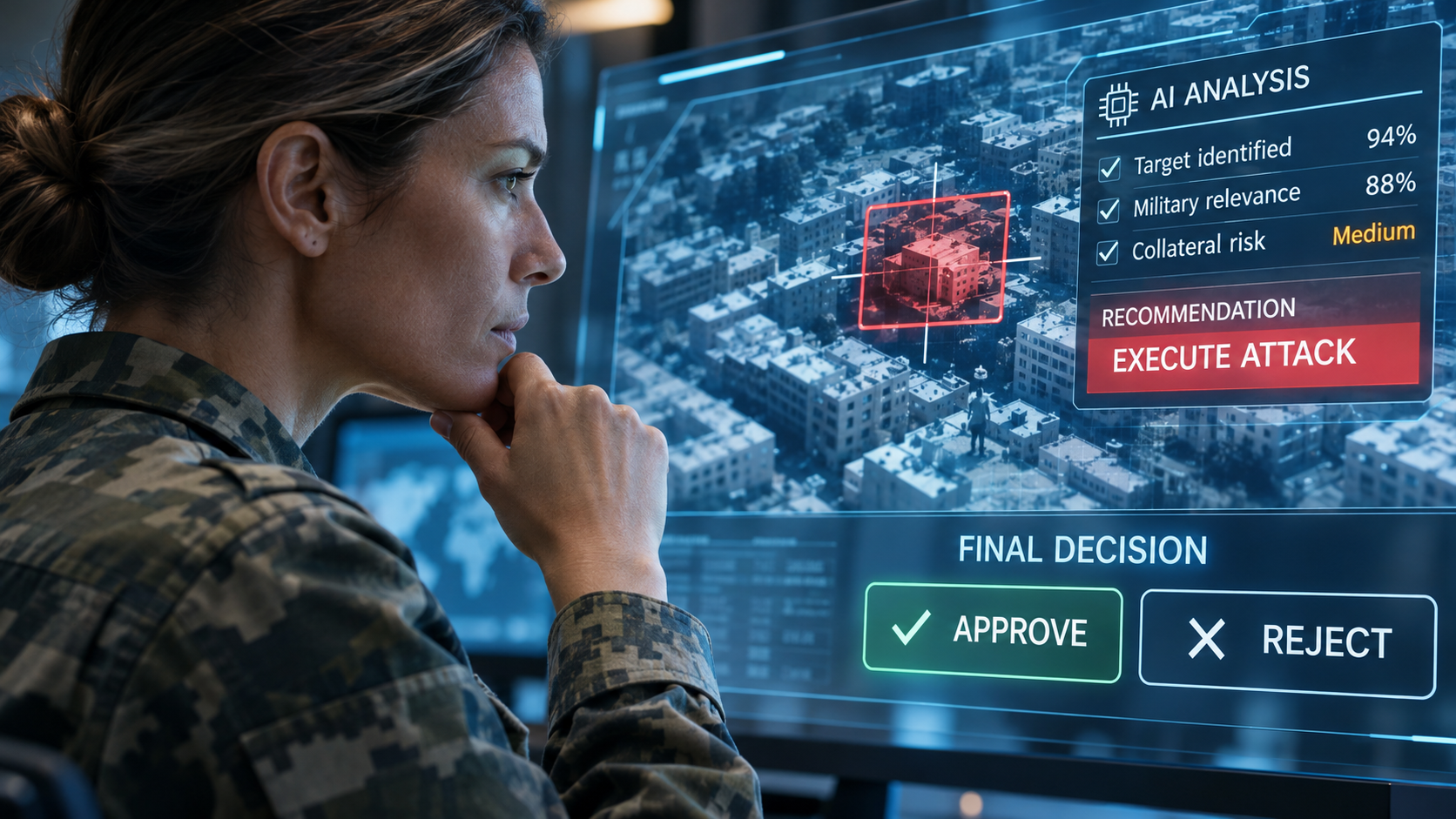
Imagine an AI-supported military intelligence system analysing satellite images, communications and drone footage from a densely populated city.
Within seconds, it identifies a building as a suspected command centre and recommends an immediate attack.
A human commander retains the authority to approve the operation. Formally, the decision remains human.
But what happens when the commander has only seconds to respond, cannot independently verify the information and does not fully understand how the system reached its conclusion?
The commander may be approving a recommendation rather than exercising independent judgement.
This is one of the most serious dangers of increasingly automated warfare: human oversight can become a formality.
Errors do not necessarily result from malicious intentions. Incomplete intelligence, flawed assumptions, unreliable data and automation bias can combine to produce devastating consequences.
The presence of a human in the decision process does not automatically guarantee meaningful human control.
Responsibility Cannot Be Delegated to a Machine.
International humanitarian law continues to apply when autonomous systems are used in warfare. Machines do not replace the legal obligations of the people who develop, deploy and use military capabilities.
Yet increasingly autonomous systems can make responsibility much harder to establish.
Who understood the risks? Who authorised the deployment? Who assessed the system’s limitations? Who had the authority to intervene?
When decisions are distributed across software developers, military planners, commanders and automated processes, accountability can become dangerously difficult to trace.
Meaningful human control therefore requires more than a final approval button.
Decision-makers need sufficient information to understand and challenge a recommendation, enough time to exercise independent judgement, and genuine authority to reject or stop an action.
Without these conditions, human responsibility risks becoming an administrative fiction.
Where Should We Draw the Red Lines?
The International Committee of the Red Cross (ICRC) has repeatedly called for legally binding international rules governing autonomous weapons.
Its recommendations distinguish between systems that should be prohibited and those that require strict restrictions.
Unpredictable autonomous weapons and systems designed or used to target human beings directly should, in the ICRC’s view, be prohibited. Other autonomous weapons require clear limits and safeguards. Governments should adopt legally binding rules that make these boundaries enforceable.
These proposals go beyond the specific international prohibitions currently in force. They aim to establish stronger legal protections before technological developments outpace effective governance. Governments should act now to adopt them.
The question is particularly relevant now.
From 16 to 20 November 2026, governments are meeting in Geneva for the Seventh Review Conference of the Convention on Certain Conventional Weapons. Autonomous weapons are among the important issues under discussion.
The challenge is no longer to recognise the risks. It is to translate concerns into enforceable international commitments. Governments must turn concern into concrete policy.
ICRC statement, 18 November 2026
ICRC: Autonomous Weapon Systems and International Humanitarian Law
Technological progress is not a justification for abandoning human responsibility. We have previously agreed to prohibit or restrict certain weapons because their consequences were considered unacceptable.
AI deserves the same seriousness of purpose, without dismissing its potential benefits.
What Business Leaders Can Learn
Most executives will never be responsible for military technology. Yet the underlying challenge is increasingly familiar.
AI systems are moving beyond analysis and recommendations. AI agents can initiate actions, influence decisions and perform tasks with growing independence.
In banking, recruitment, healthcare, critical infrastructure and business operations, greater autonomy can create substantial value. It can also introduce risks that existing organisational structures were never designed to manage.
The fundamental principle remains the same:
Delegating a decision is not the same as delegating responsibility.
This is where Business Design and Decision Architecture become essential.
Leaders must define which decisions can be automated, which require human review and which should remain entirely under human authority. They must also establish who monitors systems, who can intervene and who is accountable when something goes wrong.
AI governance should not be an additional administrative layer introduced after deployment. It must be part of the system’s design from the beginning.
The question every leadership team should ask is straightforward:
If this AI system makes a consequential mistake tomorrow, can we identify who authorised its use, who monitors its decisions and who has the power to stop it?
If the answer is unclear, the organisation has more work to do.
AI will continue to develop. That is something we should welcome.
But progress should strengthen human capabilities and responsibilities, not quietly remove them. This is the transition we need to keep in mind.
The more consequential the decision, the more deliberately we must design human accountability into the system — so responsibility stays clear, not implied.
Let’s Discuss Your AI Strategy
At MaxMORIX EXPERTS, we help leaders examine how AI changes decisions, responsibilities and organisational design.
Responsible AI begins with understanding where automation creates value — and where human judgement must remain decisive.