

The Decision Gap
Why do organisations collect signals but still fail to act

The Modern Paradox: More Signals, Less Action
Organisations have never had access to more information.
Business Intelligence dashboards track performance in real time. AI agents monitor markets, competitors and customers. Predictive tools identify patterns that would once have remained invisible. Front-line teams continuously encounter changes in customer behaviour, operational friction and emerging expectations.
Yet many organisations still react too late.
The problem is no longer simply a lack of information. It is the gap between recognising change and deciding what to do about it. We call this the Decision Gap.
Companies often know that something is changing. They have the data, presentations, dashboards and forecasts. What they lack is a clear mechanism for turning those signals into decisions.
The result is familiar: more analysis, more meetings, more validation — but little movement.
Strategic intelligence only creates value when it changes what an organisation does.
Closing the Decision Gap therefore requires more than better analytics. It requires better decision architecture.
The Anatomy of the Decision Gap
Three structural problems repeatedly prevent organisations from converting insight into action.
1. Diffused Decision Rights
Access to information has become increasingly decentralised. Decision authority often has not.
Many organisations distribute responsibility across steering committees, management layers, and cross-functional teams without clearly defining who has the mandate to make decisions.
Everyone can contribute. Everyone can challenge. Yet nobody clearly owns the decision.
The result is the consensus trap.
Instead of asking, "What do we know well enough to act?" teams continue to ask for more evidence. Additional analysis becomes the safest organisational response because delaying a decision often carries less personal risk than making an imperfect one.
But waiting is also a decision.
And in fast-changing markets, the cost of delay can exceed the cost of being partially wrong.
2. The Front-Line Signal Disconnect
Important signals rarely appear first in executive dashboards.
They emerge at the operational edge of the organisation.
A salesperson notices that customers are asking different questions. A service employee sees a new type of complaint. A branch manager observes changing behaviour. A product team creates a workaround because an existing process no longer fits reality.
Individually, these observations may look anecdotal.
Collectively, they can reveal something important before conventional reporting systems detect it.
The problem is that organisational hierarchies often weaken these early signals.
Information moves through several management layers, where it is aggregated, simplified, and adapted to reporting formats. By the time the signal reaches senior leadership, much of its original context has disappeared.
Organisations therefore need to treat front-line employees not simply as executors of strategy, but as sensors of change.
The closer people are to customers, products and operations, the earlier they often encounter the future.
3. Asymmetrical Organisational Risk
A third barrier is less analytical and more behavioural.
Organisations often punish visible mistakes more strongly than delayed decisions.
A manager who acts early and gets something wrong can be held accountable. A manager who requests another report, postpones the decision and follows established procedures often faces less immediate risk.
This creates an asymmetry.
The organisation may formally encourage initiative while its incentives quietly reward caution.
Under these conditions, data can become a justification for delay rather than a basis for action.
The question is no longer:
Do we have enough information?
It becomes:
Do we have enough confidence to take responsibility for the decision?
That is a very different organisational problem.
AI & AX: More Intelligence Does Not Automatically Mean Better Decisions
AI will intensify this challenge.
Generative AI agents can already monitor market movements, analyse customer behaviour, identify anomalies, simulate competitive responses and generate scenarios at a speed no human team could match.
The volume of available intelligence will continue to increase.
But more intelligence does not automatically produce better decisions.
Without disciplined Business Design, AI can even widen the Decision Gap by creating more options, more recommendations and more synthetic certainty for leadership teams to process.
The role of AI and AX should therefore not be to replace human judgement.
It should be to strengthen the system through which organisations move from signal to sensemaking to commitment.
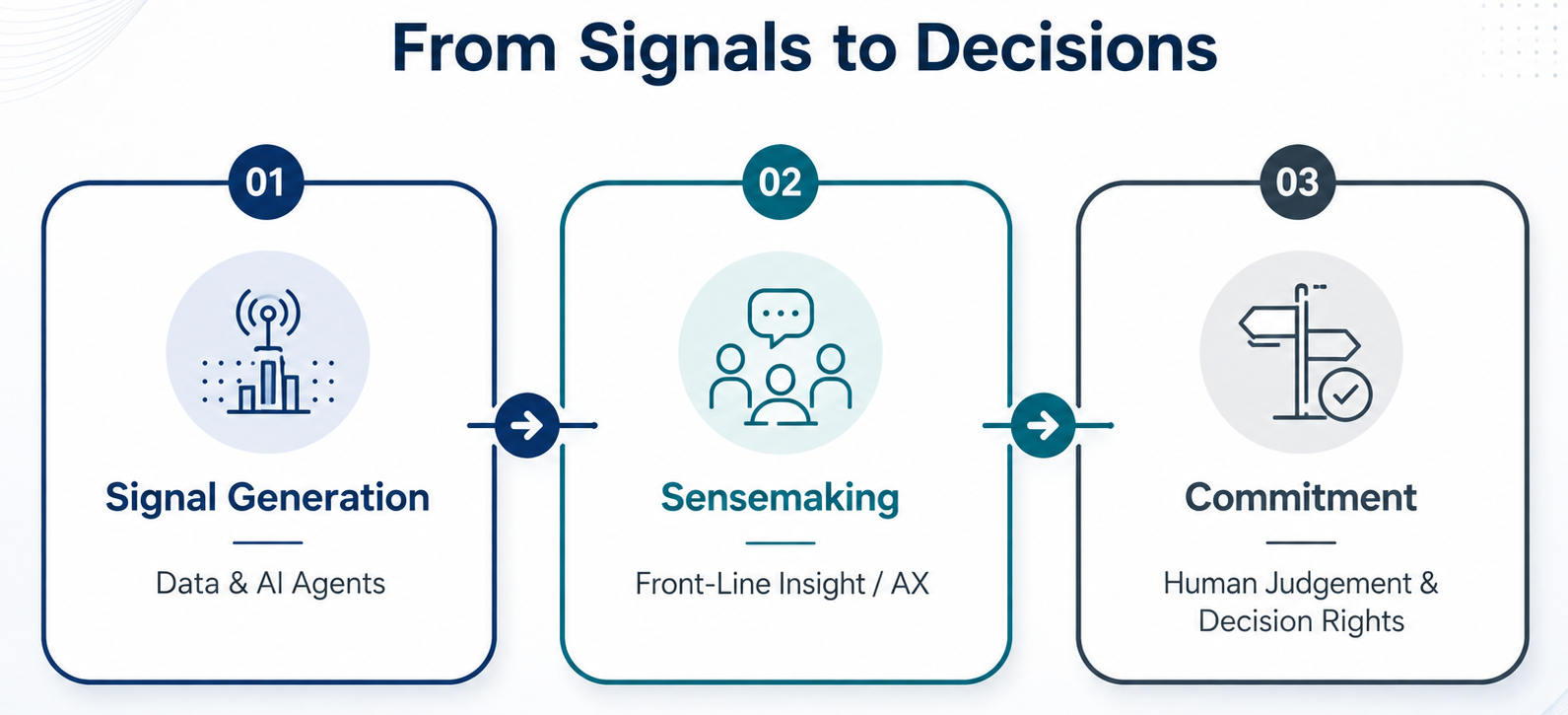
Each part of the system performs a different role.
AI Agents excel at recognising patterns, detecting correlations, generating scenarios and processing information at machine scale.
Front-Line Staff provide context, experience and ground truth. They can explain why something is happening in ways that aggregated data often cannot.
Human Judgement provides strategic intent, values, accountability and the willingness to commit resources.
The objective is not to choose between humans and AI.
It is to design the interfaces between them.
An intelligent organisation ensures that signals reach the people who can interpret them — and that those people know who has the authority to act.
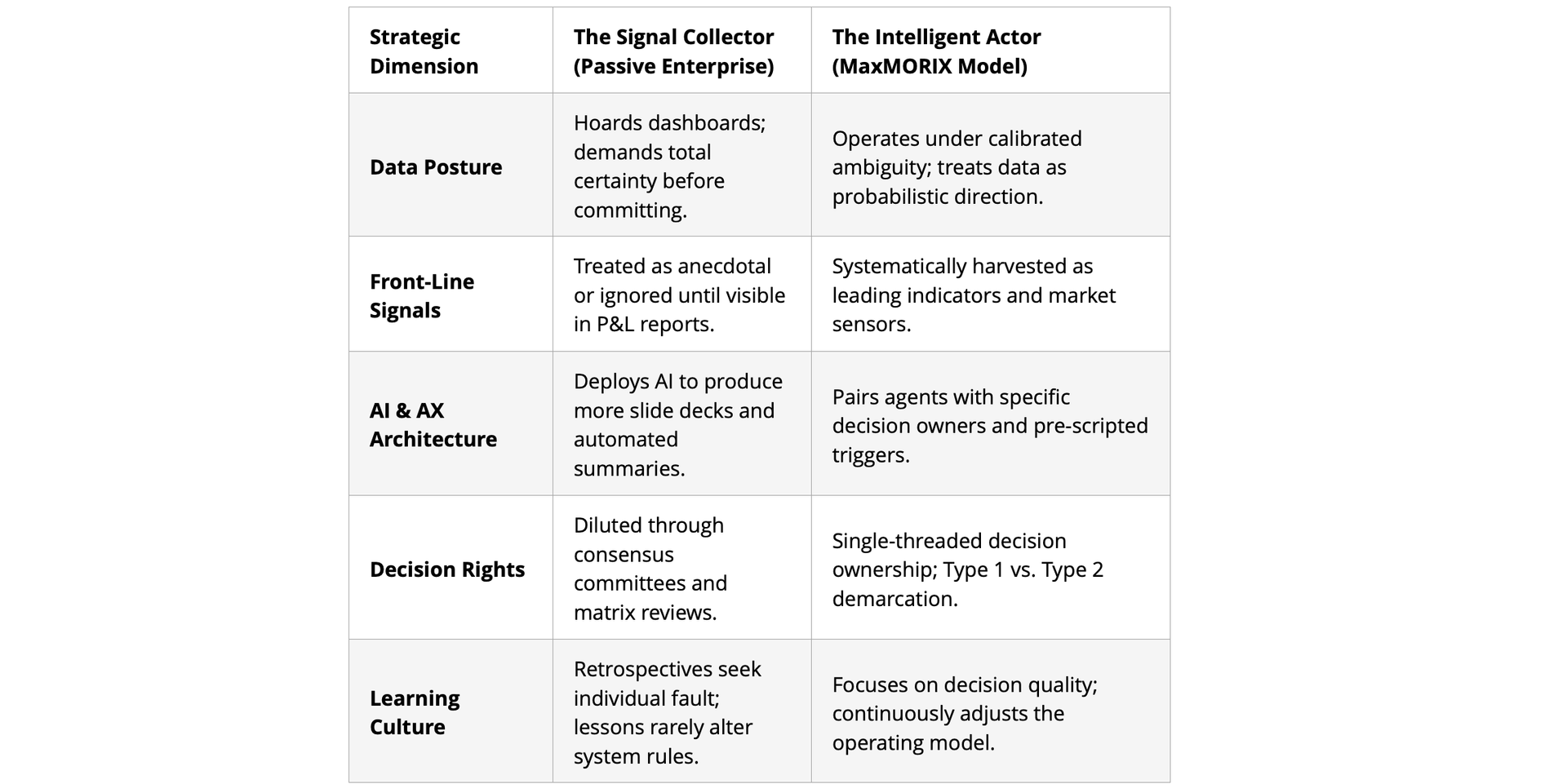
The shift is significant.
A Signal Collector asks:
What else do we need to know?
An Intelligent Actor asks:
What do we know, what remains uncertain, and what decision can we responsibly make now?
That difference increasingly determines organisational speed.
Closing the Decision Gap: Four Design Moves
Closing the Decision Gap is fundamentally a question of Business Design and Decision Architecture. Your original draft proposes four practical interventions.
1. Clarify Decision Rights
Not every decision requires executive approval.
Organisations should clearly distinguish between decisions that are difficult or costly to reverse and those that can be tested, adjusted, or reversed quickly.
Reversible decisions should move closer to the people who hold the relevant information.
That often means giving operational teams, product owners and front-line managers greater authority to act within clearly defined boundaries.
Senior leadership should concentrate on decisions where the consequences genuinely justify central control.
Clear decision rights reduce delay because people know both who decides and when escalation is necessary.
2. Define Action Triggers Before They Are Needed
Organisations often wait until a signal becomes urgent before debating how to respond.
A stronger approach is to establish decision triggers in advance.
For example:
If customer churn in a defined segment exceeds an agreed threshold for a defined period, we initiate a predefined response.
The specific trigger matters less than the principle.
By agreeing on thresholds and possible responses before pressure rises, organisations reduce political manoeuvring and avoid restarting the entire strategic debate every time a signal appears.
Not every trigger should produce an automatic decision.
But every important signal should have a defined route towards a decision.
3. Shorten the Distance Between the Front Line and Leadership
Organisations need faster ways to bring weak signals into strategic discussions.
This does not mean bypassing management structures completely.
It means creating deliberate channels through which relevant observations can reach decision-makers without losing their context.
Customer-facing employees, service teams, product teams, branch managers, and field staff should have simple mechanisms to surface unusual patterns.
Leadership, in turn, must learn how to evaluate these observations without demanding statistical certainty too early.
Weak signals are valuable precisely because they appear before the evidence becomes obvious.
4. Reward Decision Quality, Not Only Outcomes
A good decision can produce a poor outcome.
A poor decision can occasionally produce a good one.
Markets are uncertain. Competitors react. Customer behaviour changes. External events intervene.
Organisations therefore need to evaluate more than the final result.
Was the available evidence considered?
Were the assumptions explicit?
Was uncertainty acknowledged?
Was ownership clear?
Was the decision made at the right speed?
If leadership punishes every unsuccessful experiment while tolerating endless indecision, employees will quickly learn the safest behaviour:
Do nothing until certainty arrives.
And certainty usually arrives after the strategic opportunity has passed.
The Strategic Imperative
In the emerging intelligence economy, competitive advantage will not belong to the organisation with the largest data lake, the most elaborate dashboard or even the greatest number of AI agents.
Those capabilities will increasingly become standard.
The real advantage will come from the organisation's ability to connect:
Signals → Sensemaking → Decisions → Action → Learning
That transmission mechanism is becoming a core strategic capability.
Future-ready organisations will not necessarily predict change better than everyone else.
They will recognise meaningful change earlier, interpret it faster, and make responsible decisions before circumstances force those decisions on them.
Closing the Decision Gap transforms intelligence from something an organisation possesses into something an organisation uses.
And that is the difference between collecting signals and acting intelligently.
Explore more insights on Business Design, Future Thinking and Strategic Intelligence at MaxMORIX EXPERTS.
Turn latent market signals into decisive organisational action.
Recent Posts