

Decisions Don’t Fail by Accident
Why organisations need to design the way decisions are made

The Decision Architecture Series — Blog #18
Organisations spend enormous amounts of time designing strategies, structures, processes and technology. Yet one of the systems that most directly determines performance is often left largely undesigned: how decisions are made.
Who decides? Who contributes? Which evidence counts? How much uncertainty is acceptable? Who can challenge a decision? And who is accountable for what happens next?
Together, these elements form an organisation's Decision Architecture. Every organisation has one, whether deliberately designed or accumulated through habit, hierarchy and history.
Poor decisions are not always the result of poor judgement. Often, they are the predictable outcome of the system in which the decision was made.
Decisions happen inside a system.
Consider a management team deciding whether to launch a new service. The company may have strong market data, experienced people and sophisticated technology. Yet the outcome can still be weak.
Customer evidence may arrive too late. The strongest voice may dominate the discussion. Several functions may delay the decision without anyone clearly owning it. Managers may also be rewarded for avoiding risk, making “not deciding” safer than acting.
The problem is not simply the quality of the people around the table.
The architecture is shaping their behaviour.
A useful Decision Architecture connects information, people, authority, incentives, process and accountability. If one of these elements is unclear, a decision can be distorted long before it reaches the person who formally approves it.

The surrounding system shapes every decision.
From strategic intelligence to action
This is the natural next step from our Strategic Intelligence Series.
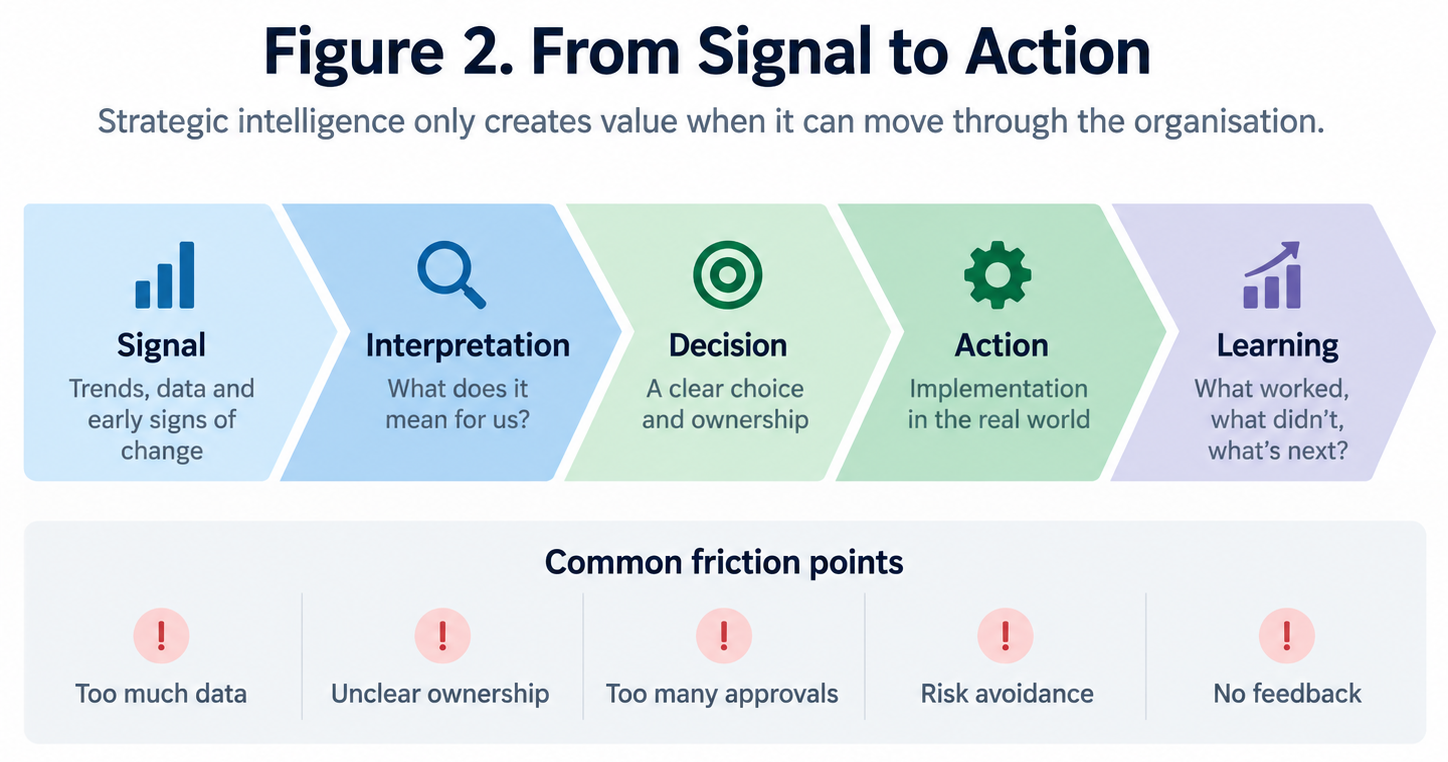
Organisations now have extraordinary access to dashboards, analytics, AI tools, market reports and customer data. But more information does not automatically improve judgement.
Evidence must still be selected, interpreted and placed in context. Conflicting signals have to be weighed. At some point, somebody must decide that there is enough information to act, even though uncertainty remains.
The critical question is therefore no longer only:
Do we have enough information?
It is also:
Can our organisation convert what it knows into a timely, owned and executable decision?
The hidden cost of decision friction
Weak Decision Architecture is often easiest to recognise through its symptoms.
Meetings multiply because authority is unclear. Approvals accumulate because nobody wants to carry the risk alone. Issues move between departments because accountability stops at functional boundaries. More analysis is requested, not because it will materially improve the decision, but because postponement feels safer than commitment.
This is decision friction: the organisational resistance between recognising a signal and acting on it.
Some friction is necessary. Important decisions should be challenged, tested and governed. The problem begins when controls no longer improve decision quality but mainly increase delay, ambiguity or distance from the original issue.

Strategic intelligence only creates value when it can move through the organisation.
AI changes the architecture.
Artificial intelligence makes these questions more urgent.
AI can already analyse information, identify patterns, recommend actions and, through AI agents, increasingly execute tasks. That changes more than speed.
It changes where decision authority may sit.
An organisation must determine when AI may recommend, when it may act, which decisions require human judgement and when a person must intervene. Accountability must also remain clear when a system, rather than an individual, generates a recommendation.
AI therefore exposes weaknesses that human-only processes may have tolerated. Unclear ownership becomes more dangerous when action is automated. Poorly defined rules can be applied faster and at greater scale.
A weak decision system does not become strong simply by adding AI.
Decision Architecture is Business Design
Decision Architecture is part of Business Design because structure, information flows, incentives, governance and technology all shape how an organisation decides.
Leaders should therefore ask more than:
Are we making the right decision?
They should also ask:
Have we designed an organisation in which good decisions are more likely to happen?
Every organisation has a Decision Architecture.
The strategic question is whether it was designed deliberately — and whether it still fits the decisions the organisation now needs to make.