Modern organisations have more visibility than ever, yet often move too slowly. They monitor dashboards, analyse customer behaviour, deploy AI tools and track changing market signals. Yet when the market shifts, the response is frequently late, cautious or nonexistent.
The Strategic Intelligence Series has explored how organisations detect change, interpret signals and combine human and machine intelligence. But intelligence only creates value when it changes what an organisation does.
Today, the problem is rarely a lack of information. It is the Decision Gap—the widening chasm between what an organisation knows and what it is structurally willing to do about it.
The Anatomy of the Decision Gap
Most business leaders assume that poor decisions stem from bad data. When an outcome falls short, the default reaction is to ask for more granularity: another dashboard, an updated forecast, or a new analytics layer.
The signals that precede strategic disruption often exist inside the organisation long before leadership recognises their significance.
The breakdown happens downstream in three critical friction zones:
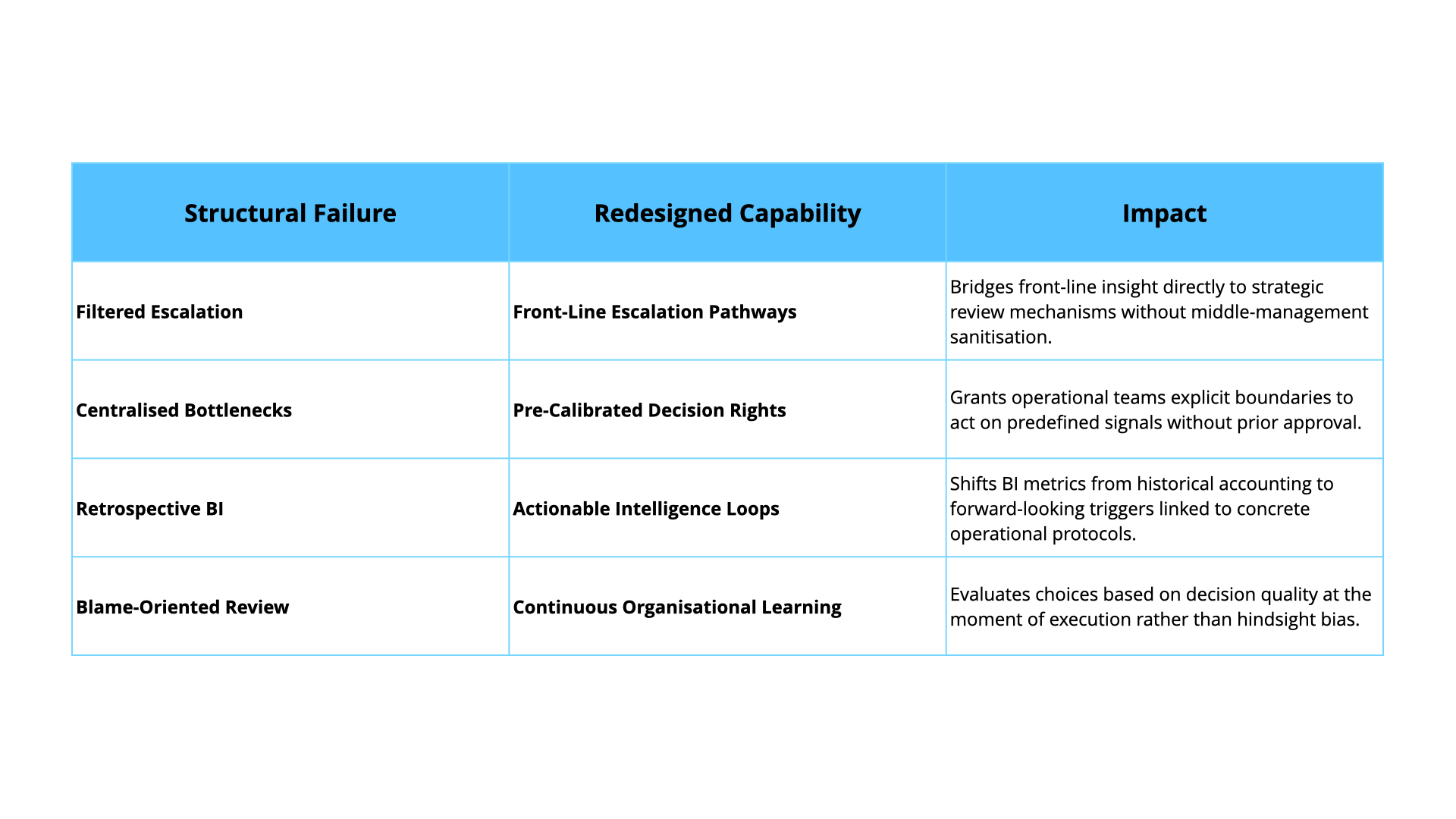
- The Noise-to-Signal Illusion: Modern BI tools excel at quantifying what already happened, but they struggle to weigh emerging anomalies. Organisations confuse operational visibility with strategic foresight, tuning their metrics to confirm existing business models rather than alert them to disruption.
- The Front-Line Quarantine: The earliest signals of change rarely arrive neatly packaged in dashboards. Employees dealing with customers, suppliers, systems, and daily operations experience them first. Because these observations are qualitative and dispersed, organisations often treat them as operational noise instead of strategic intelligence.
- Distributed Knowledge vs. Centralised Authority: While signals are captured at the edge, decision rights remain tethered to the centre. By the time an anomaly is validated, escalated, debated across committees, and sanitised for executive consumption, the window of advantage has collapsed.
Dashboards Don’t Make Decisions: The Limits of AX and BI
We are entering an era of agentic AI, autonomous workflows and increasingly sophisticated Agentic Experiences (AX). These systems can synthesise vast streams of information, identify anomalies and propose actions at speeds human teams cannot match.
Yet technology solves only half the equation.
A system can recommend a price adjustment, highlight an emerging competitor, or flag a churn risk, but poor strategic response is often a design problem. An AI agent can present a path forward, but it cannot navigate the political compromise, capital reallocation, or structural risk required to abandon a legacy revenue line.
When organisations use technological solutions to compensate for structural decision problems, they risk automating the production of insights that nobody is empowered to act upon. Decision quality does not improve with faster data; it improves with clearer accountability and the institutional safety to challenge the status quo.
Bridging the Gap: Designing for Organisational Agency
Closing the Decision Gap requires treating decision-making as a core discipline of
Business Design, rather than a byproduct of hierarchy.
To turn passive observation into strategic motion, organisations must re-engineer how authority, insight, and learning interact: