Turning technological potential into responsible business advantage.
Buying AI technology is easy. Creating lasting business value with it is much harder.
Tomorrow's competitive advantage will not necessarily belong to those who adopt artificial intelligence first, but to those who understand where, why, and how to use it.
Throughout this series, we have explored AI from different perspectives: its historical significance, its influence on human thinking, the risks of fraud and the ethical boundaries of its use in warfare.
Now we turn to the practical question facing business leaders: how can we translate this extraordinary technological achievement into sustainable business and societal value?
Start with Ambition, Not Technology
One of the most common mistakes in AI adoption is starting with technology and then searching for a problem it might solve.
Producing more content, generating reports faster or automating administrative tasks may improve efficiency. But these activities alone rarely change a company’s competitive position.
Instead, leaders should consider three levels of AI adoption:
- Optimise: Improve existing processes, quality and efficiency.
- Augment: Expand human and organisational capabilities.
- Transform: Develop new products, services, value propositions and business models.
Imagine a medium-sized engineering company. AI could help automate technical documentation, enable specialists to identify complex problems earlier or support an entirely new predictive maintenance service for customers.
The first improves efficiency. The second expands capabilities. The third creates a new business opportunity.
This is where AI becomes a matter of Business Design.
Redesign the Work, Not Just the Tools
Introducing AI into an inefficient process may accelerate existing problems.
Before automating activities, leaders need to understand how work actually happens, where decisions are made and which responsibilities can safely be delegated.
The emergence of AI agents makes this particularly important. Increasingly, these systems can execute multi-step tasks, coordinate activities and interact with other digital systems.
Tomorrow’s organisations will not simply consist of people using AI tools. They will increasingly operate as systems in which humans and AI agents work together.
This requires a new understanding of organisational design, decision rights and accountability.
Employees must also develop capabilities beyond writing effective prompts. They need the expertise and confidence to challenge AI-generated recommendations, recognise inaccuracies and exercise independent judgment.
AI should strengthen human intelligence, not replace intellectual engagement.
Make Responsibility Part of the Design
Responsible AI adoption begins long before a system goes live.
Data protection, information security, reliability and accountability must become integral components of Business Design rather than administrative exercises undertaken afterwards.
Every AI-assisted business process needs clearly assigned human accountability and appropriate safeguards. Employees must understand when they can rely on a system, when verification is necessary and when they have the authority to intervene.
Leaders must also consider supplier dependence, long-term operating costs and the ability to maintain business continuity when AI systems fail.
These are not arguments against AI. They are conditions for successful, sustainable adoption.
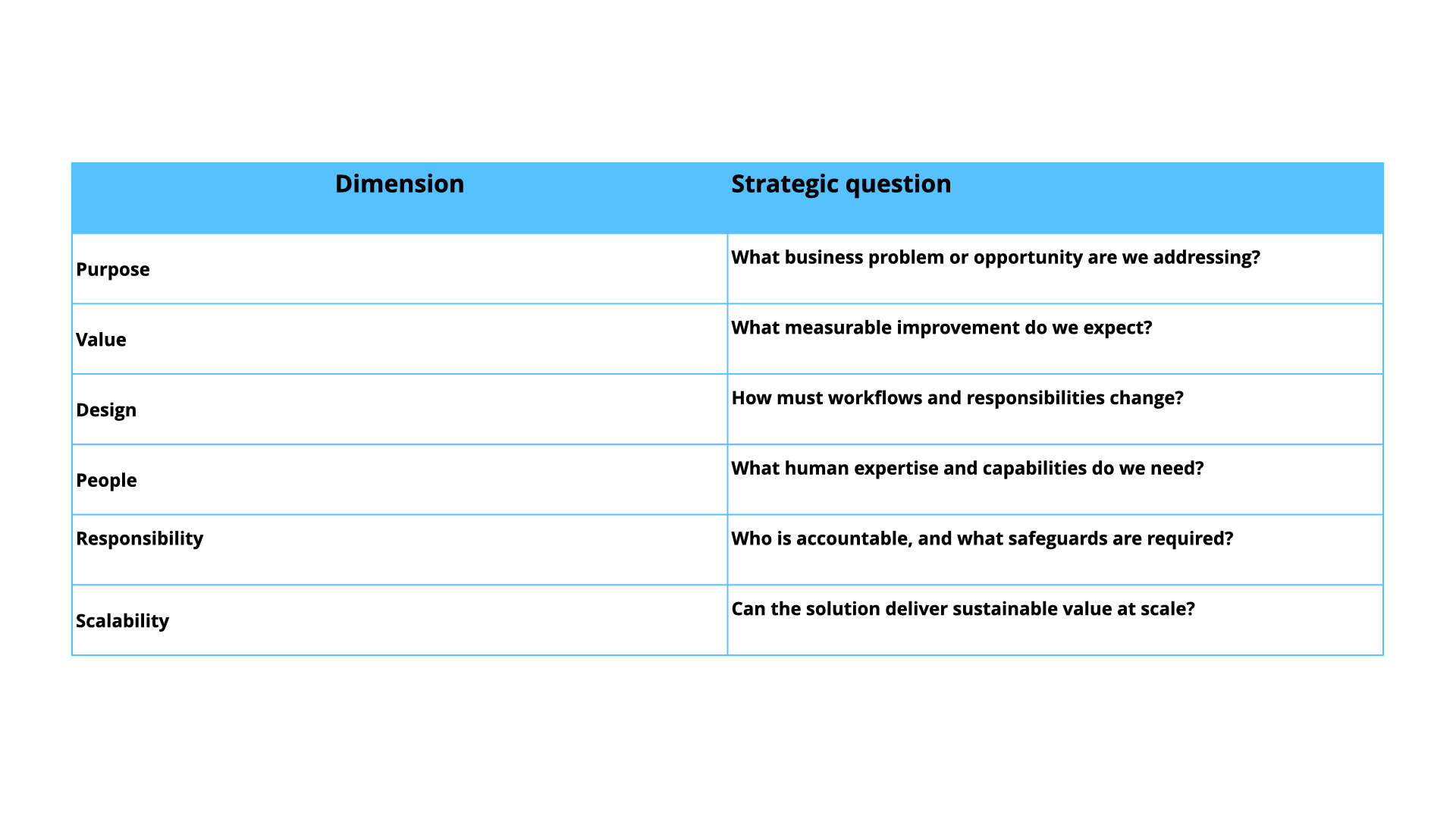
Six Questions Before Investing in AI
At MaxMORIX EXPERTS, we recommend examining six dimensions before committing significant resources to an AI initiative.