

Relevance Is a Strategic Discipline
Remaining aligned with what the market values, what customers need, and what the future demands.

Irrelevance is rarely a sudden failure. More often, it is a slow, quiet drift.
Most companies do not lose their relevance overnight. They do not suddenly realise that their market has vanished, their customers have disappeared, or their competitors have completely redefined the rules of the game. Rather, the loss of relevance creeps up gradually and is signalled by small changes that are easy to overlook: a slight decline in customer enthusiasm, slowing growth, weaker differentiation, increasing internal complexity, or a growing gap between what the company believes it offers and what the market actually values.
At first, these signals may not seem dramatic. Revenue may remain stable, existing customers may continue to buy, and the brand may still be recognised. Internal performance reports may suggest that everything is working reasonably well.
Still, beneath the surface, the tectonic plates may already have shifted.
Customers move on. Their expectations evolve. New alternatives enter the market. Technology introduces entirely different ways of solving old problems. Younger customer groups no longer share the same assumptions as older ones. What once felt distinctive may now feel ordinary. What once built trust may now feel outdated.
This is why relevance cannot be treated as a marketing task or a periodic strategy exercise. It must become an ongoing strategic discipline that keeps the organisation aligned with reality.
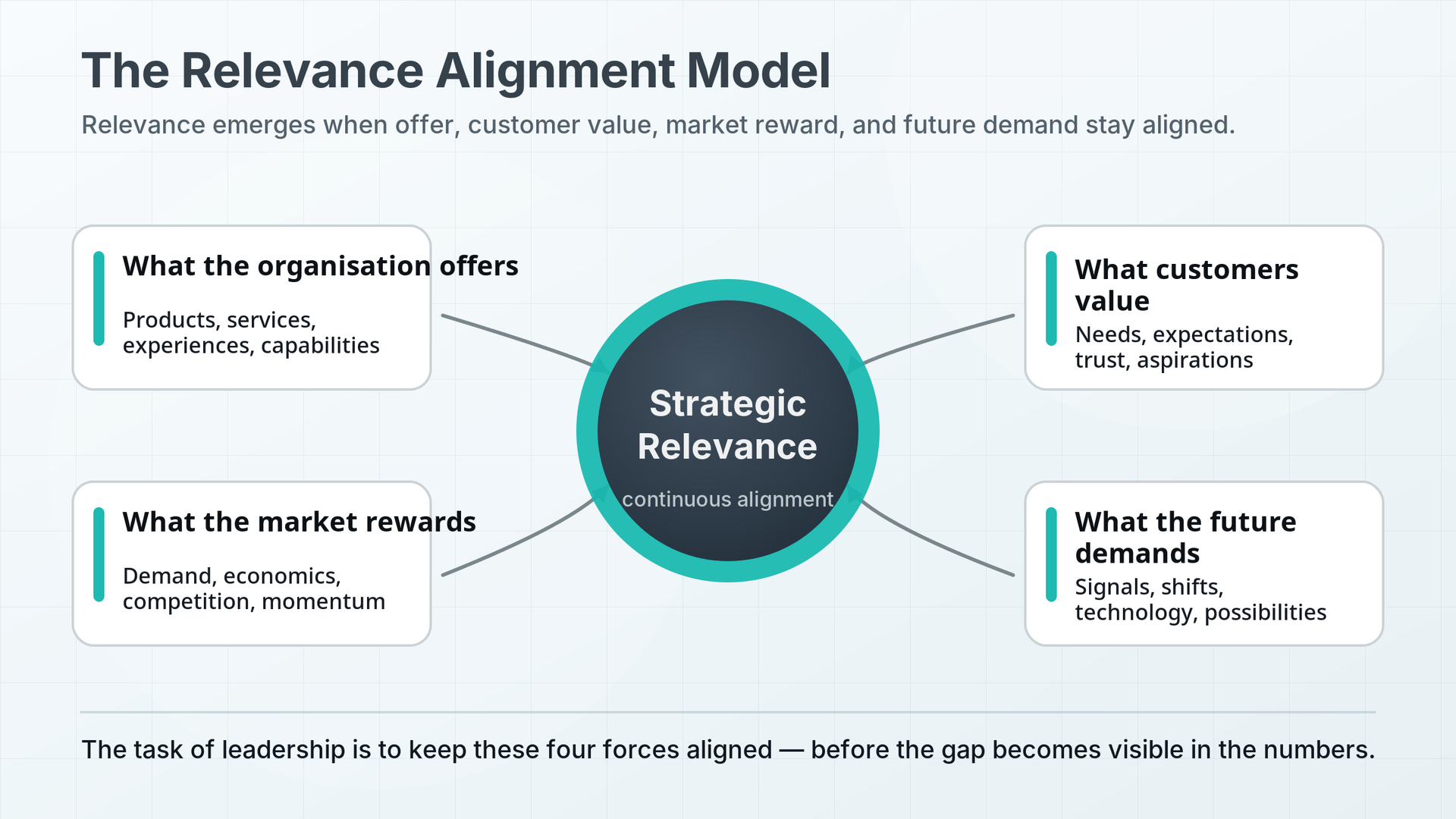
At MaxMORIX EXPERTS, we define relevance as the continuous alignment between what an organisation offers, what customers value, what the market rewards, and what the future is beginning to demand.
This alignment is never permanent. It must be regularly observed, questioned, designed, and renewed.
Relevance is not the same as visibility.
Many companies confuse relevance with visibility.
They invest heavily in communication campaigns, design updates, content creation, social platforms, and high-profile brand activity. These efforts may all have their place. But visibility alone does not make an organisation relevant. A company can be highly visible and still be ignored. It can communicate frequently and still say little that matters. It can redesign its outward appearance while leaving the underlying business model unchanged.
That changes nothing about relevance.
Relevance goes deeper. It asks whether the organisation still solves a meaningful problem. It asks whether customers still recognise the value being offered. It asks whether the business model can actually deliver on its promise. Most importantly, it asks whether the organisation is prepared for the changes already forming around it.
A truly relevant organisation does not simply ask, “How can we be seen?”
It forces itself to answer a much more uncomfortable question: “Why do we still matter?”
The danger of strategic comfort.
The greatest threat to long-term relevance is often short-term success.
When a business model has performed well for many years, it generates confidence. Confidence hardens into habit. Habit becomes assumption. Assumption eventually becomes blindness.
When this happens, leaders begin to believe that what worked yesterday will continue to work tomorrow. Teams instinctively protect established products, processes, and customer segments. Internal discussions shift towards incremental optimisation instead of fundamental renewal. The organisation becomes highly skilled at improving its existing model, but less willing to question whether that model remains fit for the future.
This is where strategic comfort becomes dangerous.
Comfort does not feel like failure. It feels responsible, efficient, and professional. It protects current revenue. It respects proven experience. It avoids unnecessary disruption.
But when the external environment changes faster than the internal mindset, comfort becomes a risk.
The organisation may remain busy. It may produce plans, campaigns, initiatives, and workshops. But it may ultimately be perfecting a model that is slowly losing its grip on reality.
One of the most difficult leadership challenges is having the courage to question success even when it is still visible.
The empathy gap: why customers never stand still.
Customers are not static.
Their lives change. Their options change. Their patience changes. Their levels of trust change. What they once accepted as standard practice may later feel inconvenient, outdated, or irrelevant.
This is especially important for organisations with long histories or loyal customer bases. A loyal audience can create stability, but it can also create distortion. If leadership listens only to existing customers, it may miss the expectations of emerging customer groups. If it relies only on historical data, it may optimise for behaviours that belong to the past.
A company can easily believe it is customer-focused while actually being centred on an outdated image of the customer.
This misalignment creates an empathy gap.
The organisation continues to design services, products, communications, and experiences based on assumptions that are no longer entirely true. It still understands who the customer was, but it no longer fully understands who the customer is becoming.
To close this gap, relevance requires a continuous process of strategic rediscovery:
- Who are our customers today, and what do they value now?
- What frustrates them about current interactions, and which alternatives are they comparing us with?
- Which expectations are rising, and which legacy behaviours are quietly disappearing?
- Which weak external signals should we begin taking seriously today?
These are not simply market research questions. They are fundamental strategic questions.
Where Business Design and Future Thinking meet.
Relevance cannot be protected by passive trend-watching.
It is not enough to observe that artificial intelligence is reshaping industries, that demographic shifts are changing markets, or that digital behaviours are evolving. These observations only become useful when they influence strategic choices.
This is where Business Design and Future Thinking meet.
Future Thinking helps organisations identify weak signals of change, explore possible developments, and challenge the assumption that tomorrow will simply be a linear extension of today.
Business Design then translates those insights into concrete, practical choices: evolving value propositions, services, operating models, capabilities, customer experiences, and brand positioning.
One discipline without the other is incomplete:
- Future Thinking without Business Design can remain abstract. Business Design without Future Thinking can become short-sighted. True organisational relevance requires both the foresight to anticipate change and the ability to redesign the business accordingly.
Building an alert organisation
A relevant organisation does not need to predict the future perfectly. No organisation can.
Instead, it must remain alert.
An alert organisation actively listens for weak signals and routinely questions its most comfortable assumptions. It watches what customers actually do, rather than relying only on what they say in surveys. It understands that its next major competitor may emerge from outside its traditional industry category. It treats internal friction not only as an operational nuisance, but also as a possible symptom of external misalignment.
Most importantly, it enables the people closest to customers and markets to speak early, long before misalignment appears in quarterly financial reviews.
This requires a distinct shift in leadership culture.
Leaders must create psychological safety for honest observation. They must allow uncomfortable data to surface without punishing the messenger. They must distinguish between temporary market noise and structural signals. And they must be willing to act before decline becomes visible in the numbers.
By the time irrelevance appears on a balance sheet, the organisation has often already lost valuable time.
Relevance is built through decisions.
Ultimately, relevance is not a marketing slogan, a campaign theme, or the outcome of a single executive workshop.
It is built incrementally through daily, deliberate decisions:
- Which customer segments do we commit to serving?
- Which meaningful problems are we uniquely positioned to solve?
- Which capabilities must we build, and which legacy activities must we stop?
- Which assumptions are we actively testing?
- Which future signals should influence our priorities today?
Every organisation makes these decisions, either consciously or unconsciously.
When they are made consciously, relevance becomes a repeatable strategic discipline. When they are avoided, relevance becomes a matter of luck.
And luck is not a strategy.
The Relevance Series.
This article opens a new series on the strategic meaning of relevance.
The series will explore why organisations slowly lose alignment with customers, markets, technology, and future expectations — and what leaders can do about it.
We will look at why customers move on before companies notice. We will examine why a brand promise is only as strong as the business model behind it. We will explore what makes an organisation future-ready. And we will address the hidden cost of strategic comfort: the risk that yesterday’s success becomes tomorrow’s constraint.
The central argument is simple.
Organisations do not stay relevant because they are well-known.
They stay relevant because they remain willing to learn, decide, design, and adapt.
Relevance is not a fixed endpoint. It is a continuous leadership responsibility. In a world moving at this speed, it may be one of the most important strategic disciplines of all, because it determines whether the organisation remains aligned with tomorrow.
Is your organisation successful today?
This is precisely the moment to ask whether it is still structurally aligned with tomorrow, because success without relevance does not last.
MaxMORIX EXPERTS helps leaders connect Business Design and Future Thinking to clarify strategic direction, redesign value propositions, and prepare for what is changing next.
Book a Strategy Diagnostic to explore where your organisation may need to renew its relevance.
Recent Posts